In 1997, Catherine David was the first women
to be appointed artistic director of a documenta – the last before
our transition to the new millennium. This led David to use as a central
motif the idea of “looking back into the future”. She presented
a critical review of the past fifty years, and simultaneously a prognosis
of the future for which David saw no traditional precedent on how
we should proceed. To describe her approach , the artistic director
coined the term “retroperspective”, which also was used
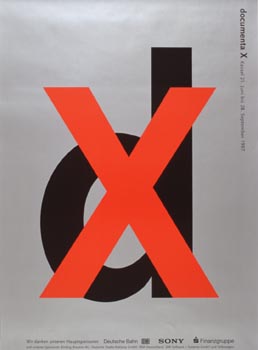
in her exhibition design. David's mission was to place dX in relation
to its predecessors, but also in the “tradition of innovation”
that was the starting point of every documenta. A further theoretical
concept underlying dX was the consideration that aesthetic production
should also incorporate its political environment in the broadest
sense of the word. David wanted to enable people to “recognize
the state of the world” in varying ways, a desire which prompted
her to define dX as a “manifestation culturelle.” Certain
key political dates for wide-reaching social and cultural upheavals,
such as 1945, 1968 or 1976/77, became chronological markers, along
which art's political, social, cultural and aesthetic exploratory
functions were traced.
With this concept in mind, David devoted most attention to those critical
artistic positions that evolved at the end of the 1960s and the beginning
of the 1970s. For instance, in an explicit reference to documenta
5, Marcel Broodthaers' “Section Publicité, Musée
d'Art Moderne, Départment des Aigles” was shown again,
which had already been on show in Kassel in 1972. Additional large-scale
work complexes by Michelangelo Pistoletto, Brazilian artists Helio
Oiticica and Lygia Clark, Dutch architect Aldo van Eyck or the “Atlas”
by Gerhard Richter were produced around that time or were begun during
this period. In addition to historical works, lines of development
were traced into the present-day.
It was likewise part of David's concept to expand the exhibition's
traditional spectrum, and go beyond the mere presentation and displaying
of works of art. Accordingly, the discussion forum „100 days
– 100 guests“ became an integral part of dX. It afforded
a platform for presentations and discussions by artists, scholars,
scientists, authors and architects on questions pertaining to art
and society – ranging from topics such as the efficacy of cultural
policies uder the conditions of a world market to questions on the
foundations of democracy. Speakers invited included the artistic director
of the coming documenta, Okwui Enwezor.