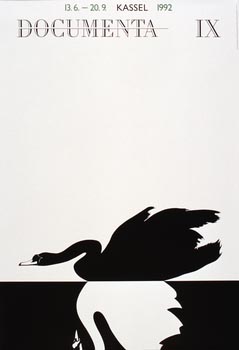
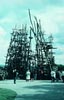
Jan Hoet, artistic director of documenta 9 in
1992, described the exhibition as “a documenta of locations”
and one based “solely on the artist and his work”. In not
pursuing a theoretical concept with documenta 9, or offering a general
thematic context, Hoet effectively broke with a documenta principle
that had decisively shaped the exhibition's character at least since
d5. Instead, Hoet saw the essential task of contemporary art to be
to provide real subjective experiences in order to counter a reality
that increasingly slipped into the virtual realm. The video installation
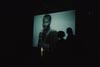
“Anthro/Sozio” (1992) by Bruce Nauman can be considered
a paramount example of this phenomenon. Displayed in the entrance
hall of the Fridericianum, it took as its topic the physical threat
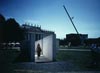
to the subject. Equally, the outside installation “Toilet”
(1992) could be interpreted in this manner, for Russian artist Ilya
Kabakov had a public Russian toilet reproduced, and made recognizable
as an apartment by positioning used furniture and personal belongings
within it.. Hoet adopted an emotional approach, and the exhibition
was experience-oriented, though he made no attempt to impose a systematic
structure on the diversity of the contemporary art scene it or to
evaluate it according to current norms. Simultaneously, Hoet succeeded
in gaining a large number of additional exhibition spaces which had
not previously been occupied by documenta, and extended the exhibition's
active radius to seven buildings and countless locations in the public
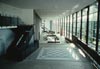
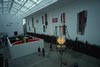
domain. Alongside the classic locations of Fridericianum and Orangerie,
new exhibition venues included: the Neue Galerie (New Gallery); the
staircase of the AOK health insurance company, and the Ottoneum (housing
a natural-history museum), temporary buildings in the Karlsaue Park
and the newly erected documenta hall behind the theatre, designed
by architects Jochem Jourdan and Bernhard Müller. The character
of the art displayed in these locations was in part adapted to the
peculiarities of the setting. The works in the New Gallery, for example,
were installed as commentaries on the existing permanent collection.
Alternately, the principle of 'displacement' was applied, under which
objects were showcased in alien contexts such as the natural history
collections of the Ottoneum.
The accompanying program of d9 included jazz, as well as boxing and
baseball. This extension of the presentation concept was understood
as a central metaphor for art and life, and was responsible in no
small way for the enormous popularity of d9. For the first time in
the history of the documenta more than half a million people traveled
to Kassel.