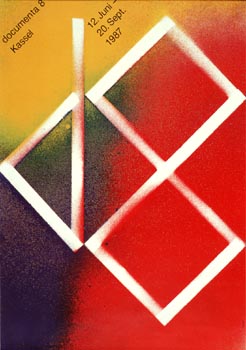
The eighth documenta in
1987 was also the second to be organized by Manfred Schneckenburger
as artistic director. It concentrated on examining art's social relevance
in the field of conflict between independence and intervention, and
sought to explore the points of contact between design, art and architecture.
However, Schneckenburger was not solely concerned with the classic
division between the freedom and the application of art. Rather, he
aimed at showing art's potential to achieve change both in the areas
of applied arts and in the field of social utopias, which in light
of current events (one year after Chernobyl) were in a state of crisis.
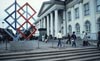
Through works by various artists on war, suppression and violence,
which were displayed in the rooms of the Fridericianum, Schneckenburger
illustrated society's present loss of utopia. This was admirably demonstrated
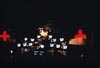
by Marie-Jo Lafontaine's monumental video installation “Les Larmes
d'Acier” (The Tears of Steel), featuring a young, athletic man
working out to the strains of a Maria Callas aria. This ingenious
combination of various pathos formulas, the monumental exaggeration
of the body cult and the uncanny connection between man and machine
in the service of aesthetics produced a disconcerting fascination
that visitors sensed both with discomfort but also enthusiasm. But
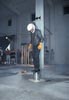
also Joseph Beuys' final large installation “Blitzschlag mit
Lichtschein auf Hirsch“, (the artist had died a year earlier),
which appeared somewhat aloof compared to the artist's earlier emphatic
awareness of change, could be interpreted in this manner. By extending
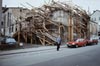
the exhibition to the entire city of Kassel, a move Schneckenburger
referred to as “critical interventions in the cityscape”,
he intended to exemplify art's possible comments on the affairs of
public life. Ian Hamilton Finlay set up a row of guillotines, which
he decorated with quotations from the bloody history of the French
Revolution, in a visual axis of the Baroque park grounds of the Karlsaue,
thereby combining aesthetics and social upheavals along the chronological
axis of the 18th century.
In sharp contrast, the artistic director's broad interpretation of
art was illustrated in the Orangerie , where architecture and design
were displayed in a context that cancelled the clear division between
art's independence and its application. Artists' contributions and
proposals varied between fatalistic designs like Austrian architects
Haus-Rucker-Co's model for a museum as a final nuclear disposal site
for art, and presentations in the mode of French artist Ange Leccia,
who stood the latest Mercedes model on a platform without any further
adornment - as a work of art.