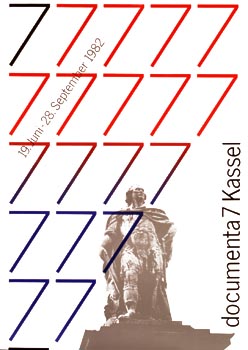
Rudi Fuchs, the artistic
director of documenta 7 in 1982, wanted to free art of the “various
constraints and social parodies it is caught up in.” Nor should
the exhibition be restricted by a theoretical concept. The works of
art should be able to “show themselves unrestrainedly”.
Fuchs emphasized the artist's individual nature, but nevertheless
saw connections between the artists themselves, as well as recognizing
their place in cultural tradition. He incorporated these ideas into
his exhibition design which elucidated the works' interrelations and
dialogs.
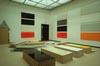
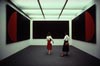
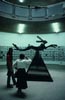
There was a clear museum-oriented character to d7. Fuchs and his assistants
stressed that as they as “did not wish to present a nervous exhibition,
but one which would do justice to the dignity of art, they had to
create peaceful conditions.” The presentation of contemporary
art – created by representatives of all generations – remained
in the traditional realm of the museum that seeks to protect art from
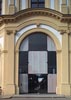
social reality. In the entrance hall to the Fridericianum, this objective
was illustrated by James Lee Byars' golden column and Jannis Kounellis'
golden wall: both demanded the return of art to something surrounded
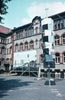
by mystique. This demand was also the subject of a work by Daniel
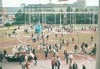
Buren (“Pennant-Text-Music”), who set up an installation
on the Friedrichsplatz featuring flagpoles and flapping pennants that
incorporated taped classical music in order to make an ironic reference
to the festivity of the occasion.
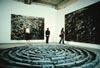
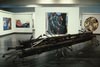
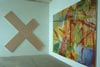
The classical genres of painting and sculpture featured strongly in
d7. In the exhibition design Fuchs devised, artworks were not specifically
arranged according to certain artistic styles, groups or geographical
correlations, but followed very individual dialogs, attempted to exhibit
underlying parallels or open conflicts. Consequently, paintings by
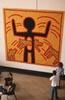
A.R. Penck were displayed alongside sculptures by John Chamberlain,
or Bruce Nauman was shown next to Keith Haring. By avoiding highlights
and focussing clearly on specific topics, this analogizing principle
– by dint of which works by the same artist were distributed
over several storeys or buildings - resulted in what was succinctly
illustrated by Lawrence Weiner's work on the Fridericianum's outer
façade: “Many Colored Objects Placed Side by Side To Form
A Row of Many Colored Objects .”
But the outstanding work of art at d7 was the work by Joseph Beuys
positioned in the documenta grounds and that still lives on in Kassel
today. For his sculpture “7000 Oak Trees” the artist had
7,000 basalt stele deposited on the Friedrichsplatz, where he also
planted the first tree. In the subsequent 5 years, the remaining 6,999
trees were planted in Kassel – each was placed alongside one
of the basalt stele – the last one on the opening day of d8 in
June 1987 by Eva Wurmbacher-Beuys, the artist's widow. Beuys died
in 1986.