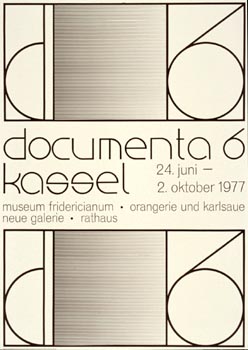
documenta 6 of 1977 faced the task of formulating
an independent, new definition of the concept of the thematic exhibition
following the extensive, encyclopaedic concept the preceding documenta
adopted. The media concept of d6, devised by artistic director Manfred
Schneckenburger, attempted to rephrase the question about the position
of art in the media society, and to do justice to the concept of art
as an independent area nevertheless rooted in society, and responsible
towards it.
Schneckenburger based his notion of art on three generations of technical
media: Photography was presented through an extensive retrospective
that not only attempted to document the medium's technical aspects
and developments, but also its communicative and content-related aspects.
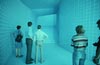
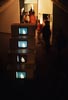
It was joined by film and video. Alongside several video installations,
e.g. Ulrike Rosenbach's “Herkules-Herakles-King Kong” (1976)
or Bill Viola's “He Weeps for You” (1976), the documenta
established itself for the first time on TV: Week for week tapes from
the exhibition's video library were broadcast by public television
stations.
In keeping with the desire to explore the problematic relationship
between art and social reality, the sculptures of d6 were often conceived
as “art in the public domain” and presented, next to the
traditional location in the Karlsaue Park, above all in front of the
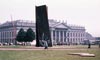
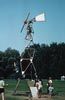
Museum Fridericianum. Thus, Richard Serra's monumental sculpture “Terminal”
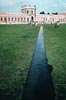
(1977), a huge structure of iron slabs and Walter de Maria's “Vertical
Earth kilometre” (1977), a bronze pole weighing 12-tons, which
transformed the Friedrichsplatz into a building site when it was sunk
into the earth prior to the opening of d6, signaled art's claim to
participate in society, even though such actions sometimes provoked
strong public reactions. At the same time, such sculptures illustrated
in an exemplary fashion the altered sculptural issues of Postminimalism
and Land Art, movements not only marked by a different understanding
of material, but also by a move out of the traditional museum rooms
and a shift in dimensions towards the monumental. In his contribution
to documenta 6, Joseph Beuys likewise sought to interpret social references
within contemporary art, by laying a system of communicating pipes
and hoses through the Fridericianum, which were fed with honey from
the “Honey pump at the workplace” located centrally in the
staircase rotunda. This installation as a system of spatial connections
sought to symbolize metaphorically the character of contemporary art
as an organic whole that forms an independent society.
Other documenta exhibits also aimed to explore the media conditions
to which contemporary art must relate: A large-scale exhibition of
artists’ books illuminated the inherent paradoxes of a medium
that is technically mass reproducible yet is frequently treated as
artistically unique. In the Orangerie a show of contemporary drawings
were linked to a similar presentation in documenta 3. On display were
700 drawings by 200 artists (from Pablo Picasso to Douglas Huebler),
whereby much space was devoted to American artists, who – with
the exception of Jackson Pollock - were totally excluded in 1964.
In contrast to documenta 3, the drawings were not arranged chronologically
but by subject.
Beyond this, Socialist Realist art from East Germany was also on display,
represented by the works of painters Willi Sitte, Bernhard Heisig,
Werner Tübke and Wolfgang Mattheuer as well as sculptors Jo Jastram
and Fritz Cremer. The presentation of this official East German art
became the section of the exhibition most talked about, and prompted
some Western participants, amongst them Georg Baselitz and Gerhard
Richter, to withdraw their contributions.