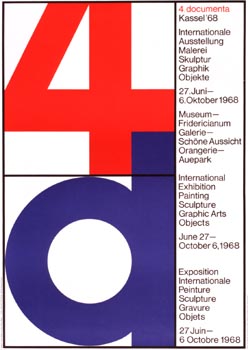
The run-up to documenta
4 in 1968 was riddled with debate and controversy, with the key question
being the very future of the documenta. The politicization of society
in the late 1960s also made itself felt in Kassel – red flags
and groups of people chanting slogans meant that the opening speeches
could not be held. Moreover, internally documenta 4 underwent a generational
conflict and a debate on the fragile relationship of aesthetic judgment
and democratic forms of reaching a consensus . The exhibition's organization
was entrusted to a so-called documenta council. At the end of the
preparations, the council had 24 members, who were sub-divided into
various working committees (e.g., for painting, sculpture, „ambient“,
etc.). The difficulty of reaching aesthetic judgments given such committee
democracy and administration, as well as the sometimes great skepticism
among some of the older members (including, for example, Werner Haftmann)
that consensus-based aesthetic judgments were possible at all, often
ended in a dead-end. Jean Leering, the young director of the Stedelijk
Van Abbemuseum Eindhoven, who was appointed head of the painting committee
after the death of two council members, took advantage of the situation
and emerged alongside Bode as the decisive figure heading the exhibition.
In deliberate contrast to its precursor, d4 presented itself as the
„youngest documenta there ever was“. All forms of retrospective
were eschewed, and the exhibition concentrated completely on current
art activities in the 1960s, doing full justice to the plethora of
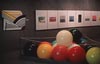
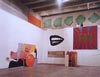
forms of artistic expression. d4 conclusively opened itself up for
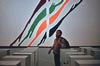
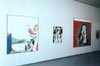
the dominance of American art, which took center stage in terms of
space with large-sized works of Post-Painterly Abstraction and color
field painting, and also offered a new understanding of our relationship
to reality with Minimal Art and Pop Art – revealing Haftmann's
hypothesis on „abstraction as a world language“ to be a
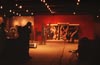
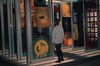
historical model. The newly-devised section on artists' environments
in the Neue Galerie – artistic spaces in which visitors are able
to move and, as with Edward Kienholz's „Roxy's“ (1961),
a reconstruction of a 1950s US brothel, were compelled to shed any
distanced stance– were the focus of attention at the show. The
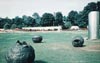
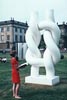
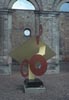
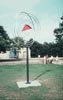
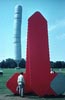
now well-established form of presenting sculptures outside the Orangerie
was changed, as the architectonic framing of the works was abandoned
and the works placed instead in loose groups on the Karlswiese meadows.
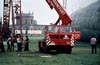
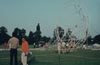
Christo's „5,600 Cubic Meter Package“ – 85 meters high
and brashly placed in the middle of the meadows– was a landmark
for the new understanding of art that no one could miss seeing.
Given the breadth of forms of artistic expression, informed by the
widest variety of different conceptions of material and reality and
by an increasing focus on theoretical issues, the exhibition organizers
realized the crucial problem, namely that viewers' habits of perceiving
artworks had not changed over the previous decades. In order to bridge
the distance between modern art production and its reception, and
no longer leave the viewer out in the cold, documenta 4 for the first
time featured a „visitors' school“ led by Bazon Brock, conveying
to those attending an understanding for the reception of art as an
act of labor in its own right, and explaining new ways of approaching
contemporary art.