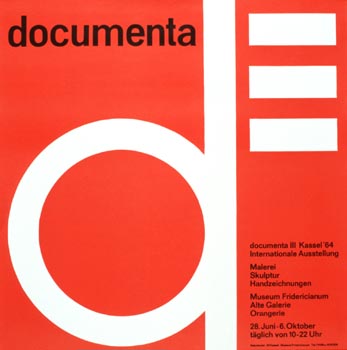
"Art is what major artists make.“ This
was the motto of documenta 3 in 1964. Werner Haftmann again tried
to justify his hypothesis on the primacy of pre-War Modernism and
for the last time the show centered on the older generation of artists
with selected works, documenting their exemplary role for contemporary
art. However, no claim was made to completeness; the artists were
purely selected according to "quality and relevance". The
special feature of d3 was that it no longer entailed showcasing various
groups of artists, but hinged on the artist as an individual. The
freedom and independence of art was something that could no longer
be construed in terms of styles and schools, but arose from the individual
creative act of an outstanding artist, although Haftmann continued
to adhere to his notion of "abstraction as world language"
and neglected those most recent trends in contemporary art which ran
against the grain of this theory.
This approach was demonstrated as a model in particular in the new
exhibition on hand drawings included in the documenta for the first
time and which Werner Haftmann considered the "most intimate
and personal form of artistic expression“. Some 500 exhibits
were on show, chosen to trace the development of Modern art, starting
with Impressionism. They included works by Cézanne and van
Gogh, Chagall, Picasso and Dix, Kokoschka, Feininger and Paul Klee,
de Chirico, Max Ernst and Miró, right up to drawings by young
Europeans such as Sonderborg, Vedova, Lismonde and Lucebert. Based
at the rebuilt Gallery of the Schöne Aussicht (now the Neue Galerie),
which, for the first time since the War, supplemented the Fridericianum
and Orangerie exhibition venues , the presentation of drawings was
intended to offer insights into the personal creative process - and
was the real sensation at d3.
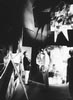
Arnold Bode's concept for the ever more intensive and evocative staging
of the works – intended, among other things, to enable the "visual
grasp of what makes creative people creative" – reached
a new spectacular climax at documenta 3. Concentrated cabinets customized
to house individual works took the reception of art to the point of
comprehensive spatial experiences. For example, three pictures by
US painter Sam Francis, which he had created for the stairwell at
Kunsthalle Basel, were presented in an hexagonal hall with natural
light from above, giving them almost a sense of holiness. The culmination
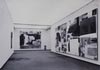
of Bode's setting was the presentation of three large-sized paintings
by Ernst Wilhelm Nay, suspended at a spectacular angle from the ceiling
of a cabinet built specially for them. It was the zenith of Bode's
concept – which, as art historian Walter Grasskamp once suggested,
Bode might have felt competed with and anticipated the spatial installations
and environments that first appeared on the scene at that same time.