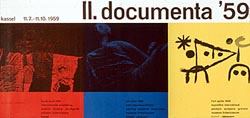
Based on the success of the first show, the second
documenta in 1959 was already made an institution: it was now organized
by a limited liability company and the conceptual realization spread
among a larger number of art historians. These experts now focused
on the post-War period, programmatically subtitling the exhibition
"Art after 1945". 1945 was conceived not only as a political
caesura. On the basis of a selection of pre-War artworks, intended
to serve as the yardstick for contemporary art, Werner Haftmann endeavored
to underscore his thesis of "abstraction as world language"
such as he had first put forward in his book "20th Century Painting",
published in 1954.
The intention was to prove the continuity of the intrinsic trend from
"art that depicts the visible to art that renders the invisible
visible" and at the same time to present abstraction as the valid
diction of post-War art.
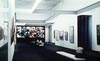
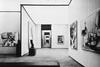
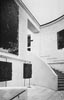
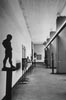
At the same time, in his exhibition design Arnold Bode homed in on
this idea, placing individual pictures along the central axis of the
Museum. Ernst Wilhelm Nay's "Freiburger Bild“ of 1956 dominated
the main hall of the Fridericianum, illustrating another innovation
in post-War art: the formats of painting had exploded and, following
in the Americans' wake, had become wall-filling manifestations of
a new, international notion of painting.
American art was likewise showcased in a broad, representative sweep
– thanks to the assistance of the New York Museum of Modern Art,
which had sent a package of 97 works – mainly Abstract Expressionism
and variants thereof – to Kassel. This act of transatlantic support
not only attested to the international nature of the documenta, but
also underlined the increasing dominance of American art in the post-War
period. The core of the avant-garde movement had shifted from Europe
to the United States. One particular artwork – Robert Rauschenberg's
controversial painting "Bed" dating from 1955 – did
not go on public show and remained in its crate: Rauschenberg was
one of the youngest generation of US artists who had severed their
links with Abstract Expressionism and thus did not support Haftmann's
proposal that said movement was valid worldwide.
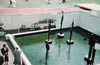
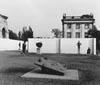
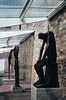
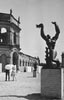
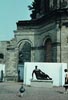
A new aspect of the d2 concept was that it featured not only paintings,
but also sculpture and prints. For the first time, the grounds of
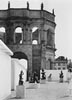
the Orangerie in the Karlsaue meadows were included in the sculpture
display. Bode staged the sculptures in front of the backdrop of the
Orangerie's set-piece architecture, surrounding it with an open structure
consisting of whitewashed brick walls, thus ensuring the sculptures
an intimacy and scale, without losing sight of the spectacular visual
effect of the ruins of the Orangerie. The formal idiom of the sculptures
– based on the impossibility of asserting that, after the horrors
of World War II, it was still possible to present images of an intact
human – were thus placed in an exciting dialogue with the architecture,
damaged so severely during the War.