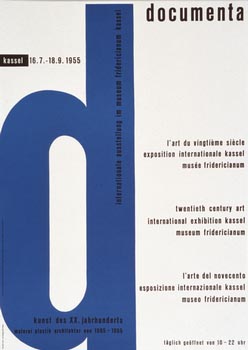
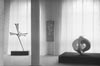
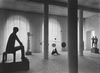
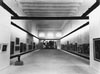
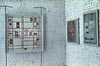
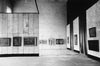
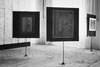
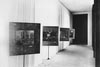
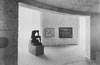
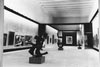
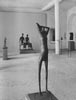
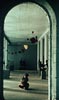
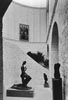
The first documenta, created by Kassel painter
and academy professor Arnold Bode in 1955, was an unexpected world
success. The exhibition, which was launched as the accompanying program
to the Bundesgartenschau (German Federal Horticultural Show) that
was held in Kassel that year, took an historical and documentary/reconstructive
approach. It showed the development of the major artistic groups since
the beginning of the century: Fauvism, Expressionism, Cubism, Blauer
Reiter, Futurism, Pittura Metafisica etc. In total, 570 works by 148
artists from six different countries were showcased, and pre-War Modernism
was deliberately displayed in all its European ramifications. Bode
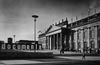
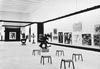
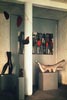
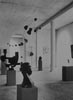
impressively highlighted the works in the ruins of the Museums Fridericianum,
today still the main building for the documenta, whose provisional
premises he outfitted with what at the time were considered extremely
modern materials (such as plasterboard and PVC curtains).
In terms of the exhibition concept, the documenta expressly manifested
its goal of directly referencing the Nazis' propaganda exhibition
"Degenerate Art" held in 1937 – in order to restore
to prominence the works, styles and artists so downgraded in the German
public's estimation as a result of the 1937 show. For example, Wilhelm
Lehmbruck's sculpture „Kneelers“ (1911), which the Nazis
had placed in a central location in the 1937 show, was again placed
in the entrance area of the Fridericianum, but this time with full
dignity in the stairwell rotunda. This attempt to reverse the way
specific artists had been considered and thus recontextualize their
work was supplemented by a centrally positioned walls of photos with
portraits of the artists, thus celebrating the individual creative
minds behind the works.
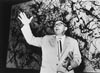
Werner Haftmann, art historian and the conceptual brain behind documenta
1-3, described the intention of the first documenta as follows: "It
should be seen as a broad, if initial attempt, to regain international
contacts across the board and thus at home re-engage in a conversation
that has been interrupted for so long, as it were.“ Haftmann
believed that the exhibition also had a didactic brief: “It is
devised with our young generation in mind, and the artists, poets
and thinkers they follow, so that they may recognize what foundations
have been laid for them, what inheritance they must nurture and what
inheritance must be overcome.“
Thus, alongside a retrospective glance at the past 50 years, attention
was also directed toward contemporary art. The idea was, on the one
hand, to take intellectual stock of things, to enquire what possibilities
there were for taking up the artistic positions of the first half
of the century and, on the other, to identify the role young German
art could play in the international scene. In this regard, d1 was
the first post-War forum where German and other European artists met
again.